Categories
Uncategorized

Pardon the Interruption

“When you come to a fork in the road, take it.” — Yogi Berra

Nearly 125 inmates and outside volunteers recently gathered for a Kairos Prison Ministry monthly reunion. The purpose of this evening’s theme — “interruptions to the natural order of things” — was to wake us to the realization that disruptions to normalcy may be God’s invitation to encounter Him and discover His plans for us. The emcee for the evening pointed out some Biblical examples, Saul’s encounter with Jesus on the road to Damascus, for instance — the Pharisee would become an apostle. There was Moses at the burning bush — the one raised in Pharaoh’s household would lead the Exodus from his land. We could point to Abraham, Joseph, Job, and many more whose life changed at various points of interruption. Most likely, we could look in the mirror and find one more.

Some discontinuity comes as welcome relief, such as when hopelessness encounters hope and heartache finds healing. For instance, one prison resident recalled, “I had always set walls around me, but I took them down on my Kairos Weekend in 2003, and I have had no walls since then.” Kairos was, for him, a positive disruption, a welcome life-changer. Some interruptions, however, are traumatic, such as difficult diagnoses, relationships in wreckage, or monetary meltdown.

So what do we do when normalcy is disrupted, whether seemingly for the good, or seemingly for the bad? Trust; we must choose to trust. “Trust in the Lord with all your heart, and do not lean on your own understanding. In all your ways acknowledge him, and he will make straight your paths.”1 Notice God’s command to trust, and His promise to act. For God’s faithfulness is not dictated by circumstance, rather in sovereignty He “works out everything in conformity with the purpose of his will.”2 So whether God causes an interruption or merely allows it, of this we can be sure: God will subject all things to Himself, for in all things, “God works for the good of those who love him, who have been called according to his purpose.”3 God is sovereign over all things and He will act. In God we trust.

“The steadfast love of the Lord never ceases; his mercies never fail; they are new every morning; great is your faithfulness.” — Lamentations 3:22-23 ESV

Father, You are sovereign over all things, and all things must be subjugated to Your will. Help us to remember this amid life’s unexpected interruptions and to place our trust in You. You are good. In Christ we pray. Amen.

1 Proverbs 3: 5-6 ESV
2 Ephesians 1:11 NIV
3 Romans 8:28 NIV

Categories
Uncategorized

Judgment Versus Judgmentalism

Watching my brother get into trouble with our mother was great spectator sport for me. Two years his junior, I must confess some guilty pleasure as Eric squirmed a bit under the microscope of scrutiny in Mom’s court of correction. I was more than willing to chime in and help her make her point — for the good of the family, of course. Occasionally in doing so, however, I’d expose my own culpability, at which point Mom would look at me with her “you just stepped in it” grin and intone, “Paul, your halo slipped.” It was the difference between judging and judgmentalism: Our mother was speaking truth for my brother’s own good; I, on the other hand, was there for the schadenfreude.

Our culture views judgmentalism as rooted in malintent — a heart set on faultfinding, accusation, and condemnation — and therefore rightly holds it in contempt. Furthermore, we who presume to declare judgment over others have sin issues of our own, which adds an unbecoming element of hypocrisy and the scorn that comes with it. The Bible translation “The Message” says in its ultra-paraphrased way: “Judgmental criticism of others is a well-known way of escaping detection in your own crimes and misdemeanors. But God isn’t so easily diverted. He sees right through all such smoke screens and holds you to what you’ve done.”1 Jesus similarly challenges us, “Why do you look at the speck of sawdust in your brother’s eye and pay no attention to the plank in your own eye?’”2 But God’s heart toward us in judgment is good, “For the eyes of the Lord run to and fro throughout the whole earth, to give strong support to those whose heart is blameless toward him.”3 He, and only He, is blameless when He judges.4

Jesus’s words on the mount echo still to us today, “Do not judge, or you too will be judged.”5 We are called to “judge all things”6 in a discernment sense, but we are specifically commanded not to presume to know and condemn the thoughts, words, or deeds of others. Then how do we navigate this tricky terrain? First, check your heart. Have you presumed to know what is impossible for you to know, namely the heart of another? Second, remember. We face a common enemy who “pushes our individual buttons” with temptations, deceptions, and lies to which we are susceptible. And third, set judgment aside and pray. People don’t need our verdict; they need our help.

Speak and so act as those who are to be judged under the law of liberty. For judgment is without mercy to one who has shown no mercy. Mercy triumphs over judgment. — James 2:12-13 ESV.

Father, as you have called me in your grace, grace me to extend it as I am called today. In Christ I pray. Amen.

1 Romans 2:2 MSG
2 Matthew 7:3 NIV
3 2 Chronicles 16:9 ESV
4 Psalm 51:4 NASB
5 Matthew 7:1 NIV
6 1 Corinthians 2:15 ESV

Categories
Uncategorized

You’re Pure for Sure

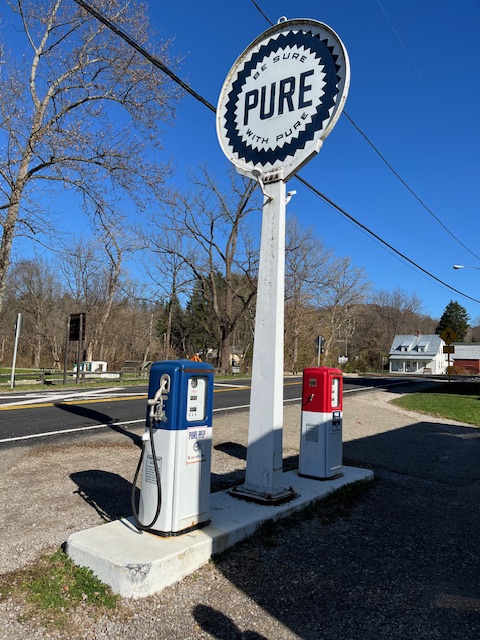
Do you remember Pure gas stations? Their slogan, “Be Sure with Pure,” was something of a losing proposition, seemingly, for in the late 60s its parent company rebranded Pure as Union 76. It seems people were willing to tolerate a little dose of impurity in their gas tanks, after all. So it is likewise with our spiritual life: we accept some measure of impurity; in fact, our sin nature prefers it. But God does not.

Sometimes we errantly look upon God’s mercy as a “replacement” for His judgment, as if sin is no longer sin — or no longer to be judged as sin — and as though sin has somehow outlasted God’s Word and won the day. For example, a pastor friend once mused about sexual sin clearly condemned in the Bible. “I think under the new covenant, it may no longer be a sin,” he said. I was stunned, for by no means will God ever taint His purity through capitulation. Such would be unmerciful to us.

To understand God’s mercy, we must understand our sin. By its nature, sin separates us from God, as David confessed in song, “No evil can dwell with You.”1 Isaiah proclaims of humankind, “your wrongdoings have caused a separation between you and your God.”2 Moreover, even “our righteous acts are like filthy rags.”3 And lest we think God grades us on a curve, James warns us, “For whoever keeps the whole law but fails in one point has become guilty of all of it.”4 It is into this squalor that God’s mercy brilliantly shines.

Then to understand God’s judgment, we must understand His purity. Sin must be completely eradicated, but how could a flawed people so separated by sin from God even begin atone for our sins, let alone succeed in doing so? Only God’s sinless life can sacrificially atone for a people made in His image. And so it is that God “made Him who knew no sin [Jesus] to be sin in our behalf, so that we might become the righteousness of God in Him.”5 This sinless Jesus “gave Himself for us to redeem us from every lawless deed, and to purify for Himself a people for His own possession, eager for good deeds.”6 In Hebrews we read, “Such a high priest truly meets our need — one who is holy, blameless, pure, set apart from sinners, exalted above the heavens.”7 In His purity, Jesus withstood God’s judgment and, in His mercy, He purifies all who live in Him. In Christ, we’re pure for sure. He makes us so.

Then, “since we have a great priest over the house of God, let us draw near with a true heart in full assurance of faith, with our hearts sprinkled clean from an evil conscience and our bodies washed with pure water.8

Be sure. You’re pure.

Father, thank You for Your judgment of sin, and thank You for purifying us through the sacrificial atonement of Your Son. In His name we pray. Amen.

1 Psalm 5:4 NASB
2 Isaiah 59:2 NASB
3 Isaiah 64:6
4 James 2:10 ESV
5 2 Corinthians 5:21 NASB
6 Titus 2:14 NASB
7 Hebrews 7:26 NIV
8 Hebrews 10:21-22 ESV