Categories
Uncategorized

Smooth Pebbles

Shortly before Peggy and I married, a friend—who at age 44 seemed as old as Father Time and every bit as wise—shared this insight with me, “Marriage is like putting two rough stones in your pocket—their edges catch and wear on each other, and over time they become two smooth pebbles.” Looking back now, 35 years later, his was a fair simile for our marriage: our understanding of each other has only grown, we appreciate our differences more, and we trust each always has the best interests of the other in mind.

Appealing to the Ephesian believers, Paul urged them to persevere as one: “Make every effort to keep the unity of the Spirit through the bond of peace. There is one body and one Spirit … one Lord, one faith, one baptism; one God and Father of all, who is over all and through all and in all.”1 He went on to explain that each of us uses our own gifts to support each other, “so that the body of Christ may be built up until we all reach unity in the faith and in the knowledge of the Son of God and become mature, attaining to the whole measure of the fullness of Christ.”2

There is a point in our maturation process when we realize that, together, we grow in ways we could never grow alone. In fact, we cannot reach “the whole measure of fullness of Christ” by ourselves—it’s not a solo act. Paul’s teaching should not surprise us, for unity is the very nature of God, and it is Jesus’ desire that we live in it. Hours before His betrayal, He prayed to the Father on our behalf, “… that they may be one as we are one: I in them and you in me. May they be brought to complete unity to let the world know that you sent me and have loved them even as you have loved me.”3

Oneness takes humility and trust—which can be scary—but together we rise to heights of joy and reach to depths of love otherwise unattainable. So we unite, using personal gifts for the common good, submitting pride to humility, discarding harshness for gentleness, replacing blame with forgiveness, rejecting retribution in mercy. We grow up into Christ together, smooth pebbles from rough stones.

Father, how wise your ways. Send your Spirit to move us to a place we have neither the ability nor the inclination to go on our own—to unity with each other and in you. This is your will; may it be so. Amen.

Make my joy complete by being like-minded, having the same love, being one in spirit and of one mind. Do nothing out of selfish ambition or vain conceit. Rather, in humility value others above yourselves, not looking to your own interests but each of you to the interests of the others. (Philippians 2:2-4)

1 Ephesians 4:3-6
2 Ephesians 4:12, 13
3 John 17:22, 23

Categories
Uncategorized

Draw Near

Are you familiar with “lead indicators” and “lag indicators”? The latter display the results of our efforts; they are the scoreboard to which we look to see if we’re winning or losing. Report cards and sales figures, for instance, post current results of activities past. Lead indicators, on the other hand, measure the efforts that produce results. Hours devoted to study portend our final grades, and the number of cold calls impacts future sales. Pay attention to lead indicators, and the score will largely take care of itself.

Occasionally, people ponder this life lag indicator: “Is my spiritual life better than it was a year ago?” After all, growth is good, right? Yet this worthy aspiration brings with it the temptation to look to the do’s and don’ts of spiritual infancy as relevant indicators of spiritual maturity. When early Christians so regressed, Paul chided them, “Why, as though you still belonged to the world, do you submit to its rules: “Do not handle! Do not taste! Do not touch!”?1 When others similarly stumbled, the apostle appealed incredulously, “Are you so foolish? After beginning with the Spirit, are you now trying to attain your goal by human effort?”2 This is not to say there is no right or wrong or bad or good—there certainly is—but the Law of Moses never could change our hearts, nor can we look to this external code as a scoreboard of spiritual growth. Our inner progress is actually the Spirit’s success, for it is He who transforms us over time. He pours Himself into us, evidenced by the character that flows out from us—“love, joy, peace, patience, kindness, goodness, faithfulness, gentleness and self-control,” taught Paul, adding, “Against such things there is no law.”3

Then what is our role regarding fruitful growth? Two words come to mind: Draw near. We read in Hebrews, “Let us draw near to God, with a sincere heart in full assurance of faith,”4 confident in what Jesus has done for us on the cross. “Come near to God and he will come near to you,”5 echoes James. It is relationship God desires from us—closeness and trust, unity and rest. It means learning about God’s love in His word, stepping into His love through trust, and opening up to Him in submissive, honest and relational prayer. Draw near to God; the scoreboard will take care of itself. He’ll see to it.

Father, your proactive love for me is beyond imagination. Strengthen and lead me into intimate time with you today. Give me discernment to know your voice, believe your truth, and grow up in your love. Amen.

1 Colossians 2:22
2 Galatians 3:3
3 Galatians 5:22, 23
4 Hebrews 10:22
5 James 4:8

Categories
Uncategorized

Health Food

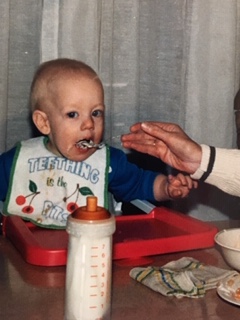
I remember the first time Peggy and I fed our son, Matthew, something other than milk. He was too young to form words, but he didn’t need any, because the contortion on his face conveyed everything that needed to be said: he was not pleased. (In all fairness, oatmeal would have been an easier transition step than carrots. Sorry, Bud.) Maturing the pallet is not an easy endeavor—infants graduate from milk only to encounter vegetables, those unwanted intruders banished to the outer reaches of toddlers’ plates everywhere. If it weren’t for persevering parents, they would eschew the nutrients they need in favor of the flavors they want.

Early church leaders understood the importance of spiritual nourishment, yet they also knew our capacity to ingest Kingdom truths evolves over time—it is a process. “Anyone who lives on milk [is] still an infant,” we read in the letter to Hebrew believers, “But solid food is for the mature.”1 What is spiritual milk? The writer goes on to describe elementary Biblical teachings: turning to God in faith, resurrection from the dead and facing eternal judgment, among others. If we’re still struggling with these truths, then Peter suggests we stick with the most elementary of foods, “Crave pure spiritual milk, so that by it you may grow up in your salvation.”2

Then our tastes grow as we grow, for “solid food is for the mature.”3 What do meat and veggies of the unseen variety look like? The Bible doesn’t provide a grocery list of senior staples, per se, but it does direct us to a daily diet of the Word: “Man shall not live by bread alone,” said Jesus to the tempter, “but on every word that comes from the mouth of God.”4 So, we expand our appetite and take in truth, rounding out our regimen with the obedience that comes from trust, just as Jesus did: “My food is to do the will of him who sent me and to finish his work.”5

Given all that’s on our plate in a worldly sense, it is easy to skip meals that strengthen us for this life and the next. It is likewise tempting to pick at a passage without even tasting it. May I encourage us above all else to prioritize time to savor Scripture? Every word—milk, meat and even carrots—is life itself, both your life and mine.

“I am the bread of life… If anyone eats of this bread, he will live forever.” (John 6:48-58)

Father, send your Spirit to slow me down and savor your word. Strengthen me in truth, and fill me with joy to do your work. In Jesus’ name, Amen.

1, 3 Hebrews 5:14
2 1 Peter 2:2
4 Matthew 4:4
5 John 4:34