Categories
Uncategorized

Without Warning

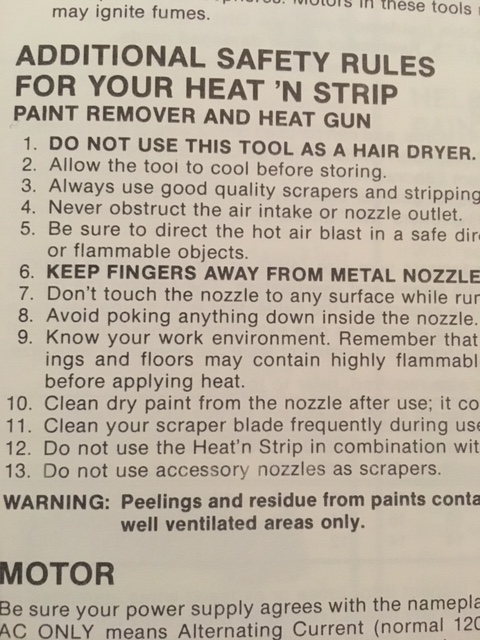
Peggy and I loved our first house, and like most first-time home buyers we eagerly got to work on making the place feel like “us.” Several coats of paint covered the baseboards and window frames, for instance, so we bought a heat gun to peel back to the natural woodwork. As I opened the package and scanned the instructions, what do you think was the very first rule on the list? “Do not use as a hair dryer.” I’m not kidding. Now, a paint-stripping heat gun can reach 1000 degrees, so I understand the manufacturer’s sense of responsibility, but what does this warning tell us but that someone, somewhere, had tried to use the tool for this very purpose?

Recalling this episode from 30 years ago, I recently snooped around a bit to see what other outrageous rules I could find. There were plenty; here are a few. Dashboard sun shade: “Do not drive with sun shield in place.” Dremel rotary tool: “This product is not intended for use as a dental drill.” Clothes iron: “Do not iron clothes on body.” And this one from a small-tractor manufacturer couldn’t have been more straight-forward: “Avoid death.” (Noted!) Why does the most brilliant species on the planet need such rudimentary rules to protect us from the obvious? Simple. It’s because common sense eludes us at times, doesn’t it?

We could look at God’s law the same way, couldn’t we? Think about it: Do not murder people. Do not steal other people’s stuff. Do not steal other people’s spouses, either. And don’t even think about making up other gods. I mean, why do we need warning labels for the basics of morality? Simple. It’s because, despite our best intentions, living in love can elude us, too. So, in the Sermon on the Mount, Jesus brought the matter home a little bit more. Don’t murder people … and don’t even hold a grudge against them. Don’t steal other people’s stuff … in fact, give to those who ask. Don’t steal other people’s spouses, either … in fact, don’t even entertain the thought, but just move on. Jesus’ point? True love is selfless, no matter the cost, regardless of outcome.

Concluding the best sermon ever told, Jesus told the people this: “Everyone who hears these words of mine and puts them into practice is like a wise man who built his house on the rock. The rain came down, the streams rose, and the winds blew and beat against that house; yet it did not fall, because it had its foundation on the rock” (Matthew 7:24, 25). He thus counseled all humankind to build our life on God’s love and truth, for real love needs no warning labels.

Jesus, your words are life. Fill us with your Spirit, that we would recall your counsel, internalize your truth, and live in the love that can only come from you. Amen.

Christ in me is wisdom.

[Click here to read today’s Scripture in Matthew 7:24-29.]

Categories
Uncategorized

Of Halos and Humility

Watching my brother get into trouble with our mother was always great spectator sport for me. Two years his junior, I would smugly look on as Eric squirmed a bit under the microscope of scrutiny in Mom’s court of correction. If I could “help” her make her point, I was more than willing to step up and serve the family in this crucial way. (After all, doesn’t the world need more moralizers?) Occasionally, however, I’d say too much and expose my own culpability, at which point Mom would look at me with her little “you-just-stepped-in-it-buddy” grin and say in a slightly lilting tone, “Paul, your halo slipped.”

It was deserved. What is it about us that loves to load the law onto the backs of others? We did it as children; we do it as adults. We did it as non-believers, and, sadly, we do it as believers, even though we’ve been set free from the power of the law and its shackles of shame. This is nothing new: the apostle Peter addressed the issue before the church council in Jerusalem two thousand years ago, “Why do you try to test God by putting on the necks of the disciples a yoke that neither we nor our fathers have been able to bear?”1 Why, indeed? So, we receive pardon from our penalties, then referee others from the rule book? There’s something wrong with this; it’s not what forgiveness and freedom are all about.

Is it still important that people under grace live in the ways that are good and right? Absolutely, and the power to do so lies in liberty, not law. “Freedom is not the permission to do what we like but the power to do what we should,”2 observed British historian, Lord Acton (paraphrased here by Os Guinness). We who deserved judgment have received mercy; we who were guilty have received pardon. We who had no right standing before God have been credited with the righteousness of Christ, and we who had no hope live fully and forever in Him. When we renew our minds and think on these eternal realities, what can possibly flow from us but endless gratitude to God and boundless grace toward others?

What happens then inside of us? Judgement fades, and encouragement flows. Blame and accusation of others give way to prayer and petition for them. And the confession of our own sins supplants our condemnation of the sins of others. We tend to our own little “halo” of grace, and celebrate the beauty of theirs.

Thanks, Mom, for the gentle correction. Nice halo, Eric.

God, help me always to remember how the reach of your grace extended to the depth of my sin. May my freedom in you yield understanding, mercy, and care toward others. In the name of Christ, I pray. Amen.

Christ in me is freedom.

[Click here to read today’s Scripture in Acts 15:6-11.]

1 Acts 15:10
2 Guinness, Os. A Free People’s Suicide: Sustainable Freedom and the American Future. InterVarsity Press. Downers Grove, Illinois. 2012.

Categories
Uncategorized

Faith Beyond Belief!

A man once said to me, “I have a hard time accepting the idea that God will only let me into heaven if I believe a certain thing or a certain way. So I live my entire life and, at the end, it all comes down to whether or not I believe something to be true? I’ve seen big changes in my friends and family members who believe, so I want to believe, but I have a hard time accepting this.” The man’s openness was refreshing, and I completely understood his skepticism. For if belief is nothing more than admitting the truth of a matter, I think he has a point. Mere acknowledgment of fact, however sincere, is something less than transformational. The apostle James gave voice to the sentiment this way: “You believe that there is one God. Good! Even the demons believe that—and shudder.”1

Biblical belief is so much richer, so much warmer, and so much more substantial than an academic nod of agreement from afar. For the foundation of our faith is so much more than a mere notion or idea; He is Jesus Christ, the Son of God, in whom life exists. Jesus assures us, “as the Father has life in himself, so he has granted the Son to have life in himself.”2 So also the apostle Paul attests of Christ, “All things were created through him and for him,” he writes, “. . . he is before all things, and in him all things hold together.”3 The belief to which God calls us, then, far surpasses mental assent; He invites us to a place called faith, where we entrust our very lives to Him in whom eternity exists. “I tell you the truth,” Jesus said, “whoever hears my word and believes him who sent me has eternal life and will not be condemned; he has crossed over from death to life.”4

Taking this cross-over step of faith, we emerge from the shadows of our hiding and enter into restored relationship with God. We experience Him as He transforms us, and we enjoy Him, for He is not a belief system of our making, but the abundant life of our longing.

If the Spirit is stirring in you to be reconciled to God through His Son, you can respond by praying:

Jesus, I know I cannot gain eternal life on my own or by my own merit. I do not live as you would have me live. For this I am very sorry. I believe you are the Son of God and that you paid the penalty for my sins because you love me. I believe you rose again to never-ending life and that you offer that life to me as a gift. I entrust myself to you, receive your gift now, and by your promise, cross over from death to life. Fill me with your Spirit and use me for your honor and glory. Thank you for your precious gift of life in me.

I write these things to you who believe in the name of the Son of God so that you may know that you have eternal life. (1 John 5:13)

[Click here to read more about salvation through faith in Christ in Romans 10:6-13.]

1 James 2:19
2 John 5:26
3 Colossians 1:16, 17 (ESV)
4 John 5:24

Today’s post is an excerpt from Christ in Me. Copyright © 2016 Paul Nordman. Used by permission. All rights reserved.