Categories
Uncategorized

From the Farmer and the King

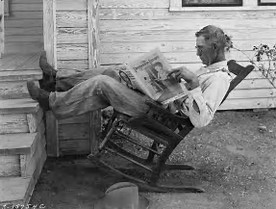
I was in my early twenties when an unassuming farmer mused to me, “There are people earning $15,000 per year and getting by, and there are people making $100,000 per year and going bankrupt. It all comes down to living within your means.” I’d always been inclined to save, but this kernel of common sense bolstered my resolve to think and act long-term.

Though tending crops and herds was not within Solomon’s kingly duties, he offered this sage advice in down-home terms an agrarian people could understand. “Be sure you know the condition of your flocks,” he wrote, “give careful attention to your herds; for riches do not endure forever, and a crown is not secure for all generations.” In other words, plan, watch, and make fully-aware decisions. Act in the moment with the end in mind.

I am now a stone’s throw away from sixty; decades of “sowing and reaping” have come and gone. Some years have yielded only financial famine, when living paycheck-to-paycheck was its own modest victory. There have been periods of pestilence, when even the savings in the silos were devoured by swarms of unforeseen expenses. Then there have been the storehouse seasons, when harvest was healthy and savings replenished.

Much lies outside our control—storms stir and insects invade, weather withers and droughts destroy. But be it through the king in his splendor or a farmer in his field, God speaks wisdom to see us through scarcity and to bless us in bounty.  Says Solomon, “There will be enough.”

Father in Heaven, inspire my mind to know your ways, and strengthen my spirit to live in them. I ask this in the name of Jesus, your Son, my Savior and Lord. Amen.

[Click here to read more common sense from Solomon in Proverbs 27:23-27.]

Categories
Uncategorized

Wind Instruments

Phil Nagy is a musician’s musician. I’ve heard him play any number of stringed instruments, carry the beat on drums, and sing some pretty difficult tunes. He can also pick up the flute, oboe, clarinet, saxophone, trumpet, trombone, baritone, and tuba! Did I mention Phil includes “band director” in his repertoire?

Every horn Phil picks up produces its own sound, different from all the others. The trumpet excites with confident blasts of high-pitched energy, the flute softening their sharp edges with soothing sensibility, and from the oboe wends an alluring enchantment one can neither mimic nor ignore. Each brass brings its own purpose, and every woodwind leaves its own effect. Yet all of his instruments share this in common: none is capable of producing even the first note by itself; it is Phil’s exhale into each horn that frees it from its silence and releases from it the great purpose for which it was crafted. And at this one man’s breath, every implement shows itself distinct.

There was a time when I favored conformity, preferring people who dressed a certain way, spoke a certain way, and lived a certain way. I surrounded myself with a circle of sameness, be it a fraternity of French horns or a clique of clarinets. Over time, however, I’ve come to savor the unique among us—the lonely bassoon with his melancholy contemplations, the piccolo who flitters in unannounced, alights in sanguine cheer, then departs as quickly as she came, and the tuba, who goes about his duties in a workmanlike manner, largely unnoticed despite his conspicuous size. For the Director has selected each in its own beauty and united them all for His composition.

In preparation for this Pentecost Sunday, take some time to sense and to savor the body of Christ, for the Holy Spirit calls and gifts each believer for the common good, just as He determines. Enjoy those who carry the tune, of course, but listen also for the softer sounds of those who serve in the background, those who, under the mastery of the Maestro, turn a mere melody into a magnificent masterpiece.

Do not offer the parts of your body to sin, as instruments of wickedness, but rather offer yourselves to God, as those who have been brought from death to life; and offer the parts of your body to him as instruments of righteousness. Romans 6:13.

Categories
Uncategorized

The Source

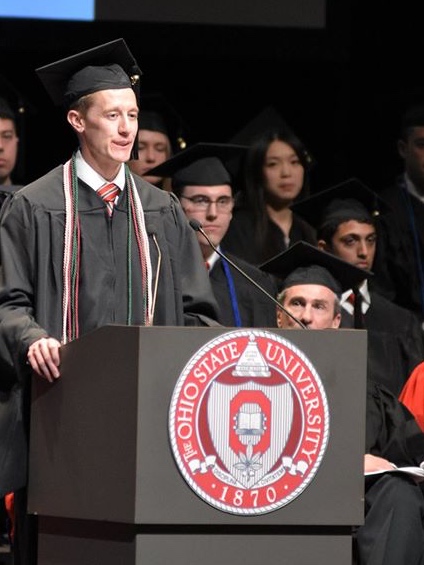
I wish I had counted the number of people who approached our son simply to say “thank you.” Completing his MBA studies, Matthew was honored to speak at his pre-commencement ceremony. He warmly recalled the shared closeness among his classmates and the care they exhibited toward each other. Then he offered his friends three charges, the first of which was this: find the source of your love. “We cannot give and give indefinitely without having a source from which we receive love; we will burn out. My source of love comes from my faith—I follow Jesus Christ who loves me so much that he died for me even though I do not deserve it. That is a source that will never run dry.” Matthew did not anticipate the applause that followed, and his parents were struck by the appreciation expressed by both friends and strangers later at the reception. His comments had found their home in welcoming souls that day.

It was Jesus’ friend, John, who taught of our union with God in Christ, the most loving provision of Him who is love by His very essence. “If anyone acknowledges that Jesus is the Son of God,” wrote the apostle, “God lives in him and he in God.” This is the heart of God toward us, evidenced through the Spirit of God within us. How could we become any closer to Him, or He to us? What could He possibly do that would be any more loving than to unite us with Himself in Spirit?

We marvel at God’s promises—in this case, the assurance of His Spirit alive in us—yet truth always travels with a companion command, an imperative, a call to respond. John continued, “And so we know and rely on the love God has for us.” For as God loves us and unites us to Himself, so we are called to love others as ourselves. Truth be told, however, on our own, we’re not all that good at loving others, for our human nature falls far short of the nature of God. So John says to us “know and rely.” To which I say, thank you, John. For when I simply accept God’s love for me, I experience an inner freedom: the onetime pressure to love gives way to a newfound desire to love, and what I once considered a demanding obligation to love becomes a welcome opportunity to love.

Recalling Christ Jesus before him, John says, “love one another.” Relying on Christ Jesus within him, John says, “We love because he first loved us.”

Yes, Matthew, He is, indeed, our source.

Father, grace me to know your love—to accept and experience it in faith—and to rely on your love as, living in the Spirit of Christ, I engage the world today. Amen.

[Click here to read 1 John 4:7-21, John’s insights into true love.]