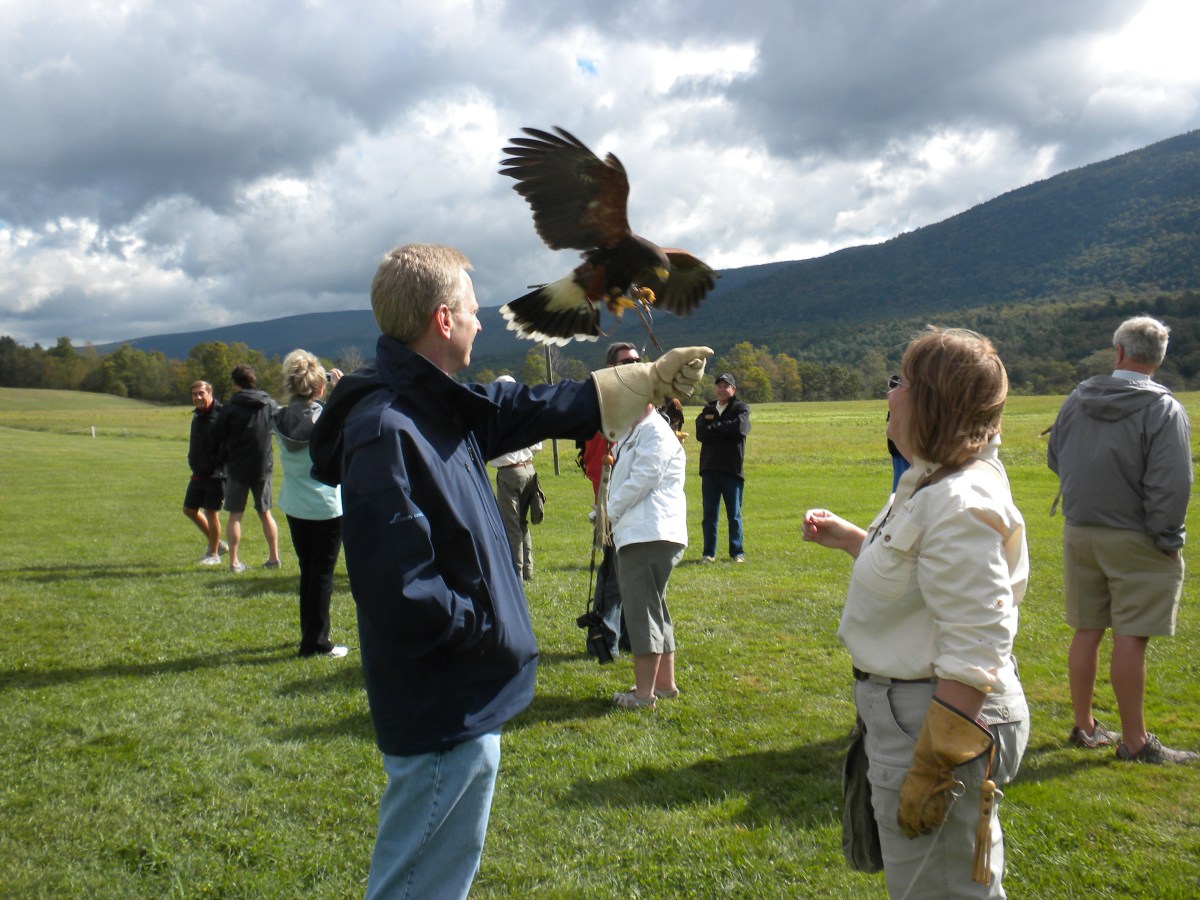
A few years ago, my wife, Peggy, and I visited The British School of Falconry in Manchester, Vermont. To have the thrill of launching birds of prey—Harris Hawks, in our case—from our arm and receiving them back again? No need to ask us twice! Let’s go!
The hawks were quite a bit lighter than they appeared, between four and five pounds, as I recall. Of course, they consist largely of feathers, so what else should have I expected? When it was time to fly my hawk—Wallace, by name—I donned a leather glove on my left arm and secured between my fingers the two straps dangling from his legs. With a heaving hoist of the arm, I released the bird, letting go of the straps at just the right instant. Wallace embraced his climb with an eager flapping of the wings, taking an arcing glide path to a high perch in the field, some distance away. There he sat watching until with sharpest vision he saw me place a single piece of steak atop my gloved fist. Then, choosing a suitable return vector, he swooped in on an admittedly somewhat-nervous me, alighting on my outstretched arm and settling in before partaking of the treat that awaited him there—London broil, served “extremely rare.”
Astonishingly, the falconer explained to us that, though he protects, feeds, and cares for these birds daily, they have no more emotional attachment to him than to us first-time visitors! So when a bird’s belly gets full enough, he loses interest in both the caregiver and the care. Instead, from his field perch, he begins to scan elsewhere for other food—mice, for instance—and is perfectly willing to leave provider and provision behind.
And I have to pause and ask myself, is this how I relate to God? Do I accept all He has to offer in my time of need and then, once nurtured, turn my attention elsewhere? In my most honest moments, I have to say, yes, sometimes I do. And while we understand why Wallace might return to the wild from which he was snatched, it makes no sense for me to go back to the ways from which I am freed. Fortunately, God knows our heart, that we’re prone to stray. So in His limitless love for us, He patiently watches over us, and when our back begins to turn away from Him, He calls us again to Himself, to His comfort and care. For we have found our home; we live freely in Him.
I have swept away your offenses like a cloud, your sins like the morning mist. Return to me, for I have redeemed you. (Isaiah 44:22)

 Paul Nordman—Author