An international student friend was trying to comprehend a relationship with God based on His love and grace instead of earning His approval through good deeds. Peggy asked her, “When you first arrived from your country and we picked you up at the airport, what if we had told you that we did it only because we were being paid to?” “I still would have appreciated the ride,” our friend replied, “but it wouldn’t have been the same.” Truth is, even believers in Christ wrestle with grace and works at times: we know we cannot earn salvation (so as to obligate God to pay us our due), but that we are freed from the penalty of our sins only in entrusting ourselves entirely to Jesus’ willing sacrifice for us. Yet Jesus himself said, “If you keep my commands, you will remain in my love, just as I have kept my Father’s commands and remain in his love.”1 This may sound as though we must earn God’s love, so how do we reconcile grace and works?
We gain life not by trusting in ourselves, but by entrusting ourselves to Jesus. “A person is not justified by the works of the law,” wrote Paul, “but by faith in Jesus Christ.”2 As we believe, “the Spirit gives birth to [our] spirit.”3 Exclaimed Jesus to the crowd, “Whoever believes in me . . . rivers of living water will flow from within them.”4 “By this,” explained John, “he meant the Spirit . . .”5 For God had foretold through the prophet Ezekiel, “I will put my Spirit in you and move you to follow my decrees and be careful to keep my laws.”6 Indeed, the Spirit’s presence in our life produces “love, joy, peace, patience, kindness, goodness, faithfulness, gentleness, self-control; against such things there is no law.”7 The Spirit will never lead us in the ways of the world, but always in the good and right ways of God. We keep God’s commandments of love not to earn our way into His presence, but because He has graciously established His presence in us.
Which brings us to works. Paul wrote that we are “created in Christ Jesus to do good works, which God prepared in advance for us to do,”8 which is to say our birth in Christ is not the end in itself, rather the beginning of a new, purposeful life. For God’s love is proactive love: He has warm, tender feelings of love, certainly, but God’s love acts and speaks. In Him there is no gap between loving feelings and loving deeds; there is no feeling without doing. “Show me your faith without deeds, and I will show you my faith by my deeds,” argued James.9
What then do we do? Draw close to God, conversing with Him in prayer and receiving from Him through His Word. Listen to the voice of the Spirit, which speaks to our heart. Watch for God working in people around us, and accept His invitation to join Him. Act and speak. For grace works.
Father, thank You for saving me in Your grace. Lead me to the works You have prepared for me, and strengthen me in Your Spirit to do them. Be glorified through this life. In Christ I pray. Amen.
1 John 15:10
2 Galatians 2:16
3 John 3:6
4 John 7:38
5 John 7:40
6 Ezekiel 36:27
7 Galatians 5:22-23
8 Ephesians 2:10
9 James 2:18
Tag: Faith
Why Wait?
Lying in the hospital bed and not permitted visitors, I had a lot of time to think. My illness was not even remotely life-threatening, but the reality of mortality consumed my thoughts. “I’m a lot closer to my ‘omega’ than my ‘alpha,’” I silently pondered, “Even if I reach my mid-eighties, that’s only 20 years away, and I’ve lived long enough to realize 20 years is short.” To be honest, I was frightened. It is one thing to ponder our demise and the hereafter in a conceptual sense, but like a mountain range, death looms larger as it draws nearer. And in the words of rhythm and blues guitarist and singer Albert King, “Everybody Wants To Go to Heaven but Nobody Wants To Die.”
Except, perhaps, the apostle Paul. Writing to the Philippian church, he poured out his heart to them: “For to me, to live is Christ and to die is gain. If I am to go on living in the body, this will mean fruitful labor for me. Yet what shall I choose? I do not know! I am torn between the two: I desire to depart and be with Christ, which is better by far; but it is more necessary for you that I remain in the body.”1 Paul realized that life in Christ has already begun—“to live is Christ,” he said—and to be with Him in heaven is better yet. So how do we hold to the same confidence that eternal life in Christ has already begun in us? “We know it by the Spirit he gave us,”2 wrote John. Christ lives in all who believe, and we gain confidence for the life to come as we experience His presence in the here and now.
My time to go has not yet come, so I’ve been thinking about how to prepare for it in the meantime, that is to say, to experience God today. Here are a few things that have proven to be helpful. Spending time with God in the Psalms is highly relational. Recalling Old Testament prophecies already fulfilled in Christ, such as Isaiah 52: 13 – 53:12, assures us today that God will keep His promises for tomorrow. Open conversation in daily prayer is refreshing and reassuring—relational, like personal psalms pouring out from within. God speaks to the heart of each of us through His Word for all of us, which is “living and active, sharper than any two-edged sword.”3 Finally, consider the difference He’s already worked in us and in so many others who walk among us as living testimonies to changes only God can make. In other words, experiencing the presence of God begins now. Why wait?
Lord, to whom shall we go? You have the words of eternal life.4 Amen.
1 Philippians 1:21-24
2 1 John 3:24
3 Hebrews 4:12 ESV
4 John 6:68
God’s Faithfulness and Our Worth
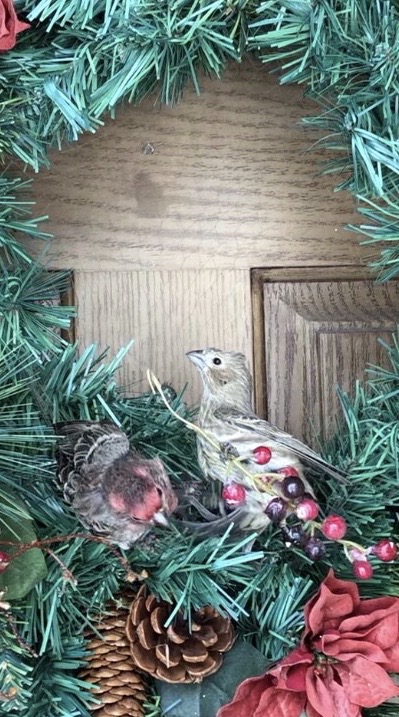
Hearing the chirping commotion commence suddenly from just outside our front door, Peggy had an inkling. Over the past several years, she had stretched a barely visible hairnet over our Christmas wreath in order to prevent birds from nesting there. This time, however, two house finches seeking shelter had made their way into the wreath’s center, apparently gaining entry from behind. Both were trapped, and one was entangled.
Donning a pair of leather gloves, Peggy used scissors to extricate the frightened couple. As she cut the netting, Mama finch was able to fly free. Papa, however, was caught in the net, so Peggy gently wrapped one gloved hand around his fragile body while speaking to him in soft tones. As she reached with the other hand to pull back the netting, he gently tapped her gloved finger with his beak and held still, seemingly trusting her to do what he could not do for himself. She maneuvered him out of the netting, opened her hand, and he flew off to join his mate.
Jesus once challenged his disciples, “Are not two sparrows sold for a penny? Yet not one of them will fall to the ground outside your Father’s care. And even the very hairs of your head are all numbered.”1 Sometimes it doesn’t feel like God knows our predicaments and entanglements or the fear that makes them worse. But He does know them—be they physical, spiritual, relational, mental or emotional—and He assures us He is in control. So we trust Him and choose to take Him at His word: “Don’t be afraid; you are worth more than many sparrows.”2 And I think we could add house finches, too.
Father, forgive me when I fear to trust You. Calm me in Your hand, and free me from my captivity, whatever form it may take. You are always good—I know this full well. Amen.
1 Matthew 10:29-30
2 Matthew 10:31